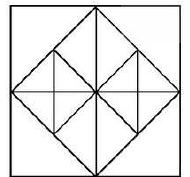
How many triangles are present in the following figure ?
Explanation:
To count the number of triangles in the given figure, we can use a systematic approach. **Step 1: Analyze the structure of the figure.** * The figure is a large square divided into four smaller, identical squares by a central horizontal and a central vertical line. * Each of these four smaller squares has its diagonals drawn. **Step 2: Count triangles within each small square.** * Consider one of the small squares (e.g., the top-left quadrant). When a square has both its diagonals drawn, it forms a specific number of triangles. * **Smallest triangles (1 unit area):** Within each small square, the diagonals divide it into 4 individual triangles. Since there are 4 such small squares, this gives $4 \times 4 = 16$ triangles. * **Triangles formed by combining 2 smallest triangles (2 unit area):** In each small square, two adjacent smallest triangles can combine to form a larger triangle. For example, the two triangles sharing a vertical side form a larger triangle. There are 4 such triangles in each small square (e.g., top-half, bottom-half, left-half, right-half of that small square). Since there are 4 such small squares, this gives $4 \times 4 = 16$ triangles. **Step 3: Sum the triangles found.** * Total triangles = (Triangles of 1 unit area) + (Triangles of 2 unit area) * Total triangles = $16 + 16 = 32$. **Step 4: Check for any larger triangles spanning across the central dividing lines.** * The figure's lines are limited to the outer boundary, the central horizontal and vertical lines, and the diagonals within each of the four small squares. No additional diagonals or lines are drawn across the entire large square or its rectangular halves. * Therefore, no larger triangles are formed by combining parts from different small squares (e.g., a triangle spanning the top-left and top-right quadrants). \nThus, the total number of triangles in the figure is 32. * **Option 1 (28):** This is incorrect. It misses some triangles, possibly by miscounting the 2-unit area triangles. * **Option 2 (30):** This is incorrect. The count is higher than 30. * **Option 3 (32):** This matches our systematic count of 32 triangles. So, this is the correct answer. * **Option 4 (36):** This is incorrect. The count is lower than 36.