ggh
Full paper with verified answers
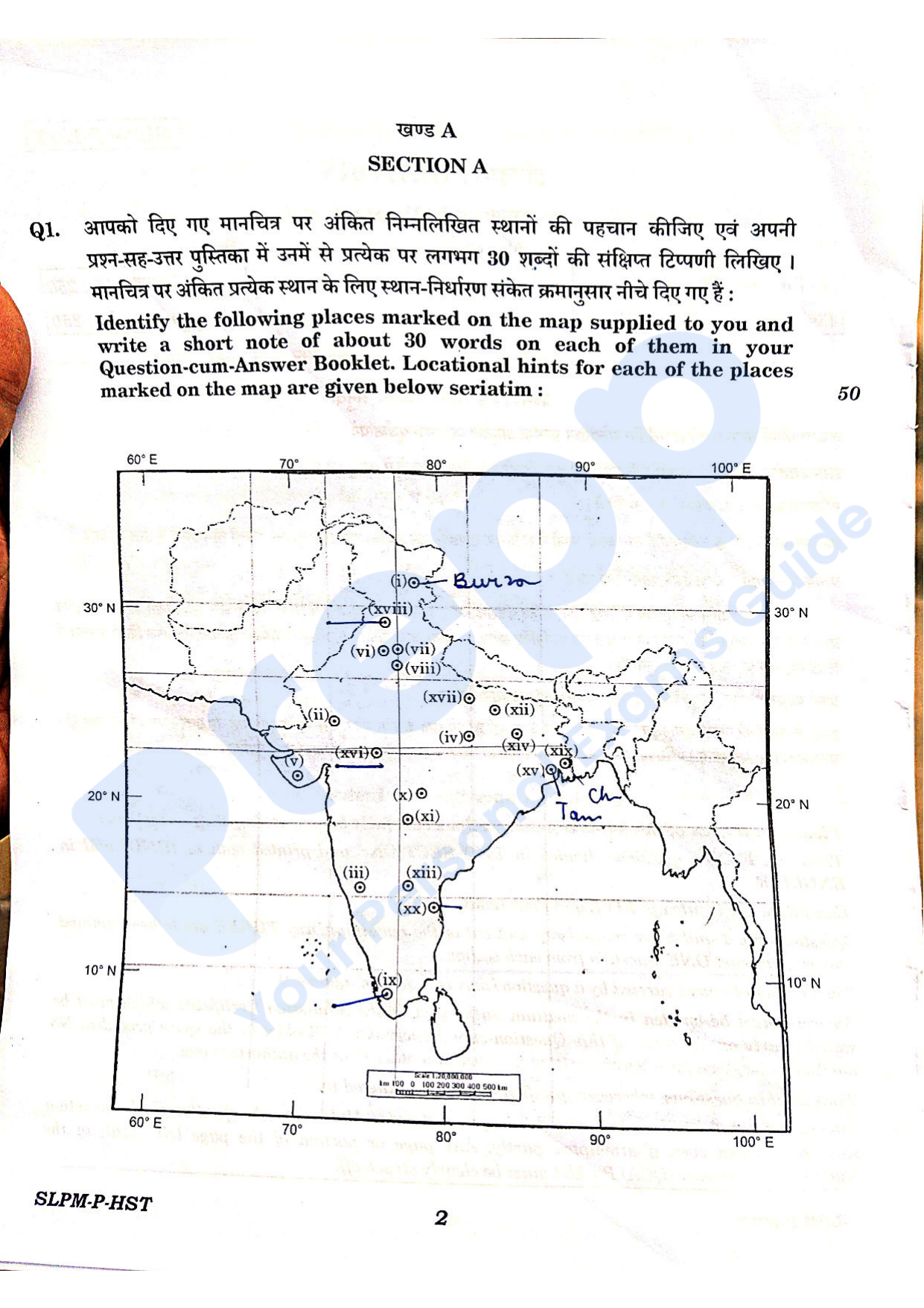
Question 1: Identify the following places marked on the map supplied to you and write a short note of about 30 words on each of them in your Question-cum-Answer B
Identify the following places marked on the map supplied to you and write a short note of about 30 words on each of them in your Question-cum-Answer Booklet. Locational hints for each of the places marked on the map are given below seriatim:
Question 2: "The Chalcolithic people were experts in microliths and were also skilful workers in stone." Elucidate.
"The Chalcolithic people were experts in microliths and were also skilful workers in stone." Elucidate.
Question 3: "The Harappans were not an artistic people." Comment.
"The Harappans were not an artistic people." Comment.
Question 4: "The ideological challenge posed by Jainism and Buddhism was deeply rooted in the socio-economic transformations brought about by the expansion of agr
"The ideological challenge posed by Jainism and Buddhism was deeply rooted in the socio-economic transformations brought about by the expansion of agrarian settlements in eastern India." Explain.
Question 5: "The origin of the territorial republics has been traced to the reaction against the pattern of life that evolved in the later Vedic period." Analyse.
"The origin of the territorial republics has been traced to the reaction against the pattern of life that evolved in the later Vedic period." Analyse.
Question 6: How far did the Mauryans facilitate the diffusion of the material culture of the Gangetic plains ? Explain.
How far did the Mauryans facilitate the diffusion of the material culture of the Gangetic plains ? Explain.
Question 7: Examine the nature and impact of India's contacts with Central Asia during the 1st to 3rd century CE. How did these interactions influence India's pol
Examine the nature and impact of India's contacts with Central Asia during the 1st to 3rd century CE. How did these interactions influence India's political, cultural and economic spheres ?
Question 8: "The dynamics of social mobility in early medieval India were shaped by a complex interplay of caste hierarchies, religious legitimation, economic tra
"The dynamics of social mobility in early medieval India were shaped by a complex interplay of caste hierarchies, religious legitimation, economic transformation and political patronage." Critically assess how these factors collectively reconfigured the structure of early medieval Indian society.
Question 9: Discuss the circumstances which led to the conflict between the Pallavas and the Chalukyas and mention how this rivalry shaped the power dynamics in S
Discuss the circumstances which led to the conflict between the Pallavas and the Chalukyas and mention how this rivalry shaped the power dynamics in South India.
Question 10: Critically evaluate the major stages in the development of art and literature in early medieval India and explain how these stages reflected the broad
Critically evaluate the major stages in the development of art and literature in early medieval India and explain how these stages reflected the broader changes in society and patterns of patronage during the period.
Question 11: "Religious themes inspired a large section of literature in provincial languages in late medieval India." Comment.
"Religious themes inspired a large section of literature in provincial languages in late medieval India." Comment.
Question 12: "Alauddin Khilji's economic measures aimed at centralising political authority in the Delhi Sultanate." Elucidate.
"Alauddin Khilji's economic measures aimed at centralising political authority in the Delhi Sultanate." Elucidate.
Question 13: Critically assess the role of imperial Karkhanas in Mughal India. How did they reflect the ideological and functional imperatives of the Mughal State?
Critically assess the role of imperial Karkhanas in Mughal India. How did they reflect the ideological and functional imperatives of the Mughal State?
Question 14: "The principles of Sikhism represented a harmonious blend of Islamic and Indic religious beliefs and practices." Comment.
"The principles of Sikhism represented a harmonious blend of Islamic and Indic religious beliefs and practices." Comment.
Question 15: Gunpowder changed the character of warfare in India during the Mughal era. Elucidate.
Gunpowder changed the character of warfare in India during the Mughal era. Elucidate.
Question 16: Discuss the structural features of Todar Mal's revenue system and evaluate its effectiveness in standardized land revenue assessment in India.
Discuss the structural features of Todar Mal's revenue system and evaluate its effectiveness in standardized land revenue assessment in India.
Question 17: Barani's "Fatwa-i-Jahandari" was not a proper account of the Delhi Sultanate, rather a lament. Elucidate.
Barani's "Fatwa-i-Jahandari" was not a proper account of the Delhi Sultanate, rather a lament. Elucidate.
Question 18: Discuss the development of Hindi literature under Mughal patronage. How did the Bhakti and Sufi Movements influence it?
Discuss the development of Hindi literature under Mughal patronage. How did the Bhakti and Sufi Movements influence it?
Question 19: Portuguese maritime power disrupted the character of trade in the Indian Ocean in the 16th century. Review.
Portuguese maritime power disrupted the character of trade in the Indian Ocean in the 16th century. Review.
Question 20: Akbar's Rajput policy was shaped by considerations of factional politics in the Mughal court. Discuss.
Akbar's Rajput policy was shaped by considerations of factional politics in the Mughal court. Discuss.
Question 21: Evaluate the impact of Mughal revenue administration on the agrarian structure of North India. To what extent did it bring continuity and change in th
Evaluate the impact of Mughal revenue administration on the agrarian structure of North India. To what extent did it bring continuity and change in the rural socio-economic fabric?
Question 22: "Aurangzeb's religious policy was a reflection of the changed political realities of the Mughal Empire." Elucidate.
"Aurangzeb's religious policy was a reflection of the changed political realities of the Mughal Empire." Elucidate.
Question 23: Define the rise of distinct provincial architectural styles under the Mughal Empire in light of structural diversity, cultural interaction and the nat
Define the rise of distinct provincial architectural styles under the Mughal Empire in light of structural diversity, cultural interaction and the nature of provincial power dynamics.
Question 24: Identify the following places marked on the map supplied to you and write a short note of about 30 words on each of them in your Question-cum-Answer B
Identify the following places marked on the map supplied to you and write a short note of about 30 words on each of them in your Question-cum-Answer Booklet. Locational hints for each of the places marked on the map are given below seriatim:
Question 25: Critically examine the political, military and administrative factors that led to the transformation of the Maratha character in the 18th century. How
Critically examine the political, military and administrative factors that led to the transformation of the Maratha character in the 18th century. How did these changes influence its rise and eventual decline?