History Optional 2023 Paper I
Full paper with verified answers
Question 1: Identify the following places marked on the map supplied to you and write a short note of about 30 words on each of them in your Question-cum-Answer B
Identify the following places marked on the map supplied to you and write a short note of about 30 words on each of them in your Question-cum-Answer Booklet. Locational hints for each of the places marked on the map are given below seriatim:
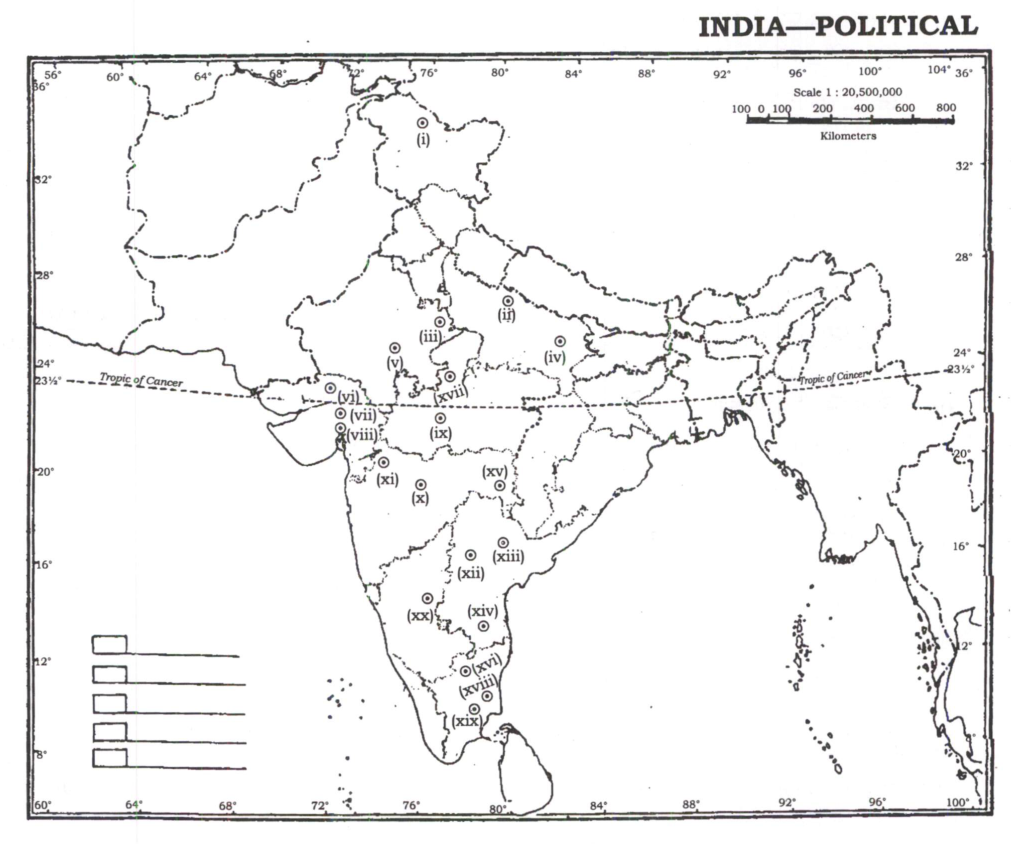
(i) Neolithic site (ii) Site of Mother and Child Terracotta Figure (iii) Hoard of Gupta Coin (iv) Site of Botanical remains (v) Harappan site with mud-brick platform (vi) Mauryan reservoir site (vii) Capital of Maitraka dynasty (viii) Dockyard (ix) Rock shelter (x) Stone axe factory (xi) Satavahana inscription site (xii) Minor rock inscription of Asoka (xiii) Buddhist Stupa (xiv) Mesolithic site (xv) Iron smelting workshop (xvi) Megalithic site (xvii) Temple site dedicated to Surya (xviii) Roman factory site (xix) Site of Muvar Koil (Temple of Three) (xx) Megalith stone site
Question 2: "The Neolithic Age represents a revolution due to significant changes that took place during this period." Examine.
"The Neolithic Age represents a revolution due to significant changes that took place during this period." Examine.
Question 3: The Indus-Saraswati cultural zone exhibited both homogeneity and diversity. Discuss.
The Indus-Saraswati cultural zone exhibited both homogeneity and diversity. Discuss.
Question 4: How do the comparative study of languages, archaeological sources and vast corpus of Vedic literature help to determine the Aryan problem in Indian hi
How do the comparative study of languages, archaeological sources and vast corpus of Vedic literature help to determine the Aryan problem in Indian history? Discuss.
Question 5: How far the Sangam literature acts as a window into the social and cultural traditions of ancient South India?
How far the Sangam literature acts as a window into the social and cultural traditions of ancient South India?
Question 6: Analyze the contours of imperial ideology as exhibited during the Mauryan period.
Analyze the contours of imperial ideology as exhibited during the Mauryan period.
Question 7: Evaluate the status of women in the Gupta period as compared to the pre-Gupta era.
Evaluate the status of women in the Gupta period as compared to the pre-Gupta era.
Question 8: Analyze the tenets, spread and impact of the Bhakti Movement.
Analyze the tenets, spread and impact of the Bhakti Movement.
Question 9: How far temple architecture under the Cholas became more refined and grandiose as compared to the early South Indian temple architecture style?
How far temple architecture under the Cholas became more refined and grandiose as compared to the early South Indian temple architecture style?
Question 10: Is it correct to say that the post-Gupta period was remarkable for the expansion of religious cults in India?
Is it correct to say that the post-Gupta period was remarkable for the expansion of religious cults in India?
Question 11: Discuss the various proponents of Indian feudalism.
Discuss the various proponents of Indian feudalism.
Question 12: Examine the defects in Alberuni's assessment of the Indian society.
Examine the defects in Alberuni's assessment of the Indian society.
Question 13: Discuss the importance of Sufic literature as an important source of history.
Discuss the importance of Sufic literature as an important source of history.
Question 14: What factors do you attribute for the decline of the Delhi Sultanate?
What factors do you attribute for the decline of the Delhi Sultanate?
Question 15: The motive of Alauddin Khalji's agrarian policy was to curb the powers of the intermediaries. Examine the measures which he adopted to achieve his obj
The motive of Alauddin Khalji's agrarian policy was to curb the powers of the intermediaries. Examine the measures which he adopted to achieve his objective.
Question 16: Discuss the role of Nur Jahan in the Mughal court politics during the reign of Jahangir.
Discuss the role of Nur Jahan in the Mughal court politics during the reign of Jahangir.
Question 17: Why did Balban prefer 'consolidation' over 'expansion' of the Delhi Sultanate?
Why did Balban prefer 'consolidation' over 'expansion' of the Delhi Sultanate?
Question 18: What features of European paintings were incorporated in the Mughal miniature painting?
What features of European paintings were incorporated in the Mughal miniature painting?
Question 19: The Marathas posed a significant threat to the integrity of the Mughal Empire. Discuss.
The Marathas posed a significant threat to the integrity of the Mughal Empire. Discuss.
Question 20: "Haidar Ali was born to build an empire, and Tipu Sultan to lose one." Comment.
"Haidar Ali was born to build an empire, and Tipu Sultan to lose one." Comment.
Question 21: Analyze the rise of the Sikhs under Ranjit Singh.
Analyze the rise of the Sikhs under Ranjit Singh.
Question 22: Mughal architecture was syncretic in character. Comment.
Mughal architecture was syncretic in character. Comment.
Question 23: The economy of India was not stagnant in the eighteenth century. Discuss.
The economy of India was not stagnant in the eighteenth century. Discuss.
Question 24: Discuss the nature of the Mughal State under Akbar.
Discuss the nature of the Mughal State under Akbar.