History Optional 2024 Paper I
Full paper with verified answers
Question 1: Identify the following places marked on the map supplied to you and write a short note of about 30 words on each of them in your Question-cum-Answer B
Identify the following places marked on the map supplied to you and write a short note of about 30 words on each of them in your Question-cum-Answer Booklet. Locational hints for each of the places marked on the map are given below seriatim:
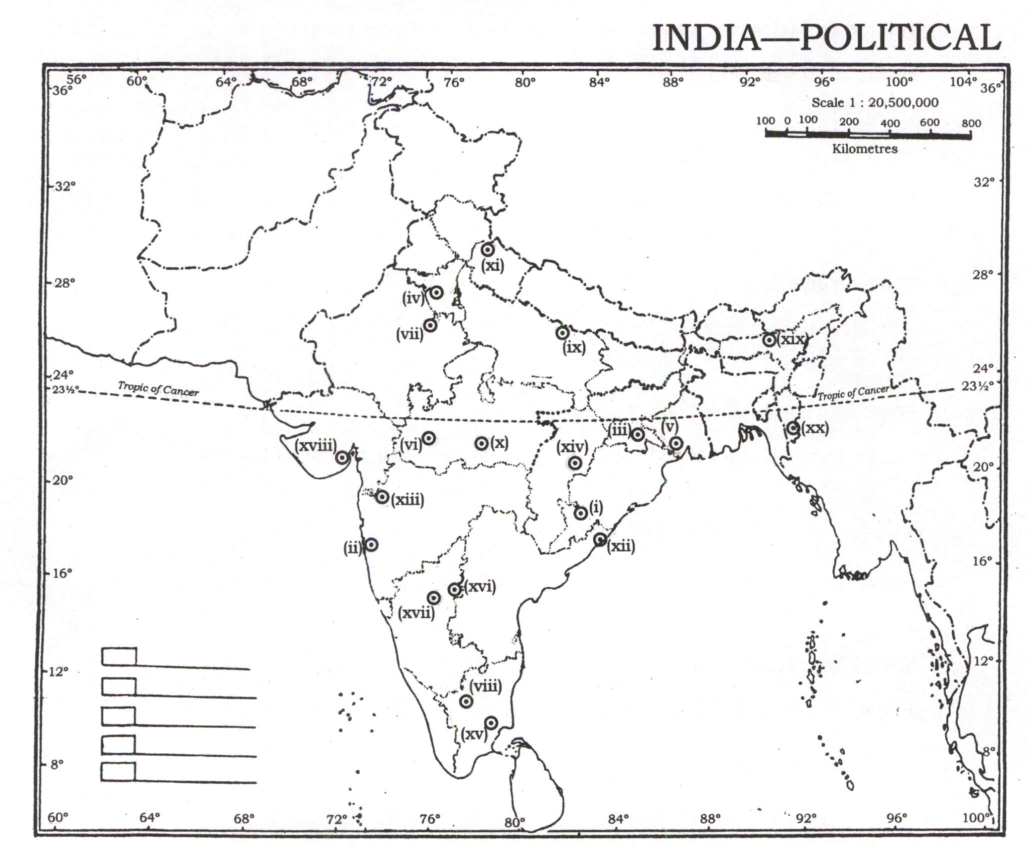
(i) Prehistoric site (ii) Area of petroglyphs (iii) Neolithic site (iv) Harappan site (v) Buddhist monastery (vi) Chalcolithic site (vii) Neo-Chalcolithic site (viii) Megalithic site with rock art (ix) One of the Mahajanapadas' capital and associated with Buddha's miracle (x) Hominid fossil find site (xi) Major rock edict of Ashoka (xii) Ancient trade centre (xiii) Stone inscription recording land grants with tax exemptions (xiv) Shiva temples named after family relationships (xv) Place of art-related inscription (xvi) Place of inscription of three languages (xvii) Temple site where three styles of temple architecture are found (xviii) Jain pilgrimage site (xix) Shiva temple of Gupta period (xx) Megalithic monumental site
Question 2: Harappan art contributes to our understanding of their aesthetic sensibilities in addition to spiritual and ritualistic life. Comment.
Harappan art contributes to our understanding of their aesthetic sensibilities in addition to spiritual and ritualistic life. Comment.
Question 3: Discuss different types of Megalithic burial practices in India. How far does the archaeological evidence from it help us to know the religious belief
Discuss different types of Megalithic burial practices in India. How far does the archaeological evidence from it help us to know the religious beliefs and cultural practices?
Question 4: Western Kshatrapas are known for their socio-economic contribution, particularly in trade, agriculture and urbanization. Examine the statement.
Western Kshatrapas are known for their socio-economic contribution, particularly in trade, agriculture and urbanization. Examine the statement.
Question 5: Symbiotic relationships between Buddhist establishments, traders, artisan guilds, and royal support led to a close proximity of religion, economy and
Symbiotic relationships between Buddhist establishments, traders, artisan guilds, and royal support led to a close proximity of religion, economy and polity in the Mauryan and post-Mauryan periods. Examine the statement.
Question 6: Discuss the role of Buddhism in shaping the socio-religious landscape of the Mauryan Empire.
Discuss the role of Buddhism in shaping the socio-religious landscape of the Mauryan Empire.
Question 7: Discuss the evolution of State institution and taxation system from Rigvedic period to later Vedic period.
Discuss the evolution of State institution and taxation system from Rigvedic period to later Vedic period.
Question 8: Highlight the contributions of Aryabhatta, Varahamihira and Brahmagupta in the fields of Astronomy and Mathematics.
Highlight the contributions of Aryabhatta, Varahamihira and Brahmagupta in the fields of Astronomy and Mathematics.
Question 9: Examine the course of Pallava-Chalukya conflicts between sixth and eighth century CE.
Examine the course of Pallava-Chalukya conflicts between sixth and eighth century CE.
Question 10: Examine the role played by the Agraharas in the promotion of education in the early medieval India.
Examine the role played by the Agraharas in the promotion of education in the early medieval India.
Question 11: Illustrate the main features of Vesara style temple architecture.
Illustrate the main features of Vesara style temple architecture.
Question 12: Evaluate Firuz Shah Tughluq's economic policies.
Evaluate Firuz Shah Tughluq's economic policies.
Question 13: Evaluate the contribution of Qalandariyyah to medieval Indian culture.
Evaluate the contribution of Qalandariyyah to medieval Indian culture.
Question 14: Discuss the main features of Malwa school of painting with examples.
Discuss the main features of Malwa school of painting with examples.
Question 15: Highlight the features of Portuguese colonial enterprise.
Highlight the features of Portuguese colonial enterprise.
Question 16: Analyze the contributions of Acharya Triumvirate to Indian Vedanta.
Analyze the contributions of Acharya Triumvirate to Indian Vedanta.
Question 17: Compare and contrast the position of Hindu and Muslim women in 13th and 14th century India.
Compare and contrast the position of Hindu and Muslim women in 13th and 14th century India.
Question 18: Examine the causes and consequences of peasants uprising during the reign of Aurangzeb.
Examine the causes and consequences of peasants uprising during the reign of Aurangzeb.
Question 19: "Instead of bringing credit, the Ibadat Khana brought growing discredit to Akbar." Comment.
"Instead of bringing credit, the Ibadat Khana brought growing discredit to Akbar." Comment.
Question 20: How did the Maratha guerrilla warfare tactics contribute to their military successes against larger and more established armies?
How did the Maratha guerrilla warfare tactics contribute to their military successes against larger and more established armies?
Question 21: Examine the role of Asaf Jahi Dynasty in the political transformation of the State of Hyderabad.
Examine the role of Asaf Jahi Dynasty in the political transformation of the State of Hyderabad.
Question 22: Discuss the contributions of Bahmani Sultans to the development of Indo-Islamic architecture.
Discuss the contributions of Bahmani Sultans to the development of Indo-Islamic architecture.
Question 23: Evaluate the impact of the Third Battle of Panipat on the political economy of 18th century India.
Evaluate the impact of the Third Battle of Panipat on the political economy of 18th century India.
Question 24: Examine the process of urbanization caused by the establishment of European trading companies in India.
Examine the process of urbanization caused by the establishment of European trading companies in India.